
🦔 🐛

Getting to know the hedgehog.

The more you know about hedgehogs, the better you can help them in everyday life. The most important facts about our prickly neighbour – compact and at a glance.

Who is this, actually?

Profile: Erinaceus europaeus

The western European hedgehog (brown-breasted hedgehog) – the hedgehog species that is at home here in the Drau valley. One of two native hedgehog species in Austria – and strictly protected. Compare it with the white-breasted hedgehog

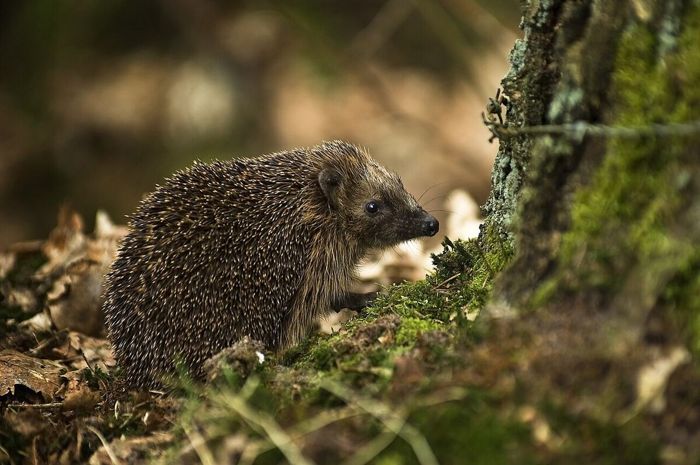
A brown-breasted hedgehog standing at the foot of a mossy tree trunk among the leaves on the forest floor Brown-breasted hedgehog strictly protected
Size
22 – 30 cm
Weight
600 – 1,500 g (healthy, in autumn)
Habitat
Gardens, hedges, woodland edges, traditional orchards
Food
Beetles, larvae and insects – never milk, fruit, nuts, grain, worms or slugs and snails!
Activity
Active at dusk and at night
Hibernation
approx. November to March/April
Life expectancy
2 – 5 years (up to 8 in care)
Spines
6,000 – 8,000 of them
Per night
up to 3 km on the move
Two species, one neighbour

Brown-breasted or white-breasted hedgehog?

Two hedgehog species of the genus Erinaceus live in Austria. They look confusingly alike – the surest way to tell them apart is to look at the centre of the chest.

Brown-breasted hedgehogErinaceus europaeus

Western and southern Austria – here in the Drau valley, it is the hedgehog that comes into our care.

Dark chest
  • Centre of the chest dark brown to greyish brown
  • Top of the head usually with a wedge-shaped dark patch
  • A V-shaped dark marking between the eye and the nose
  • Spines banded light and dark, tip usually dark
  • Found up to about 1,200 m altitude

White-breasted hedgehogErinaceus roumanicus

Eastern Austria – spread here from south-eastern and eastern Europe. Also called the “northern white-breasted hedgehog”.

White chest
  • Centre of the chest white and clearly set off
  • Top of the head uniformly dark or with a light patch
  • Spines usually with three dark and three light bands
  • Slightly smaller ears and fewer spines than the brown-breasted hedgehog
  • Found up to about 1,400 m altitude
The differences in detail
Feature Brown-breasted hedgehog White-breasted hedgehog
Centre of the chestdark brown to greyish brown, evenly colouredbright white patch in the middle of the chest
Spine patternbanded light and dark, tip usually darkusually exactly three dark and three light bands
Head and body length155 – 300 mm (15.5 – 30 cm)170 – 280 mm (17 – 28 cm)
Weight450 – 1,400 g240 – 1,200 g
Ear length20 – 37 mm20 – 25 mm
Tail10 – 49 mm15 – 40 mm
Spinesapprox. 8,000 – 8,700approx. 6,400 – 6,700
Altitude rangeup to approx. 1,200 mup to approx. 1,400 m
Distribution in AustriaWest and southEast
Distribution in EuropeWestern and central Europe (e.g. Germany, Switzerland, western Austria)Eastern Europe and the Balkans (e.g. eastern Austria, Poland, Hungary)

Both species meet in Austria

In Germany and Switzerland, only the brown-breasted hedgehog lives in the wild – there it is also called the “western hedgehog”. Austria, by contrast, is crossed by an overlap zone around 200 kilometres wide, where both species live side by side. That is exactly why it pays to take a close look at the chest here – out in the open, the white patch is the only truly reliable feature.

It makes no difference when it comes to helping

Habitat, food, hibernation and behaviour are practically the same for both species – and both are strictly protected. So if you find a helpless hedgehog, you always follow the same guidance, whichever species it is.

Feature data from kleinsaeuger.at (Kleinsäuger Österreichs – small mammals of Austria), supplemented with spine pattern, European distribution and overlap zone

In numbers

The hedgehog – a small wonder

8,000spines max.
3 kmper night
5 °Cbody temp. in hibernation
8/minheartbeat (winter)
13 x 13cm gap in the fence
How does the hedgehog live?

Three areas of life

To survive, the hedgehog needs three things: a habitat, freedom of movement – and peace and quiet.

01

The garden as a home

Hedgehogs need wild corners, leaf piles, dense hedges and access between properties – at least a 13 x 13 cm gap in the fence. Create a natural garden

02

Loners with a territory

Hedgehogs live alone and roam up to 3 km a night in search of food. Males and females only meet in the mating season.

03

Hibernation pros

Body temperature drops to 5 °C, the heartbeat to 8 beats a minute. Disturbances cost energy and can be fatal.

Diet

What does a hedgehog really eat?

The wrong food is one of the most common reasons why hedgehogs fall ill. The “milk” myth in particular is life-threatening.

What hedgehogs like

  • Beetles, larvae, caterpillars, spiders
  • Millipedes and other insects
  • High-quality wet cat food (poultry, without gravy)
  • Suitable dry cat food only in a targeted way and after asking for advice
  • Cooked, unseasoned scrambled egg
  • Fresh water – renewed daily!

Never

  • Milk – causes diarrhoea, life-threatening
  • Fruit, nuts, grain, vegetables, bread
  • Worms and slugs/snails – transmit dangerous parasites
  • Raw meat, seasoned food
  • Mealworms (they rob the body of calcium)
  • Unsuitable dry food containing grain, sugar or little meat
“If you’re not sure what you’re allowed to feed –
just give me a call. I don’t bite.” 🦔
Spot it instantly

Healthy or sick?

These signs help you tell within seconds whether a hedgehog needs help.

Healthy

  • ✓ Active at night (from dusk)
  • ✓ Pear-shaped body
  • ✓ Full coat of spines
  • ✓ Clear eyes, no discharge
  • ✓ Can roll up into a ball easily
  • ✓ Walks straight, healthy appetite
⚡

Sick · Act now

  • ✗ Active during the day (warning sign!)
  • ✗ Tube-shaped body
  • ✗ “Hunger dent” behind the head
  • ✗ Dull eyes, slimy discharge
  • ✗ Wobbly gait, lying on its side
  • ✗ Breathing noises, parasite infestation
The signs in the picture: a hunger dent behind the head, sunken flanks and a tube-shaped body point to a sick hedgehog – a healthy one is pear-shaped, has a full coat of spines and clear eyes. Graphic: Igelhilfe – Igel & Co.
→ If in doubt: open the emergency page
♂ ♀ Telling males and females apart

Boy or girl?

This matters above all with foundlings – so that siblings are not separated from each other.

  • Female: genital opening close to the anus, no “button” in the middle of the belly. ♀
  • Male: visible penis in the middle of the belly (like a small “belly button”), further away from the anus. ♂
Emergency

Found a baby hedgehog?

Eyes closed = immediate emergency. Without its mother, the baby becomes critical within hours. Please don’t try to feed it yourself – every minute counts.

! Why it matters

The house of cards of species

When species disappear, the whole system starts to wobble – because soils and climate depend on functioning ecosystems. Every species lost pulls another card out of the house of cards.

The hedgehog is not just a cute wild animal – it is an indicator. If it disappears, the foundations of life we all share begin to shake.
Just like in a house of cards, everything in an ecosystem is connected.
Natural gardens with native plants, water sources and hiding places make room for diversity again.

On the nature trail, you can experience all this first-hand.

11 stations, each with a board full of knowledge to take home. Click through – or come and visit in person.

To the nature trail →